Running as a Couple: When Passion Is Shared
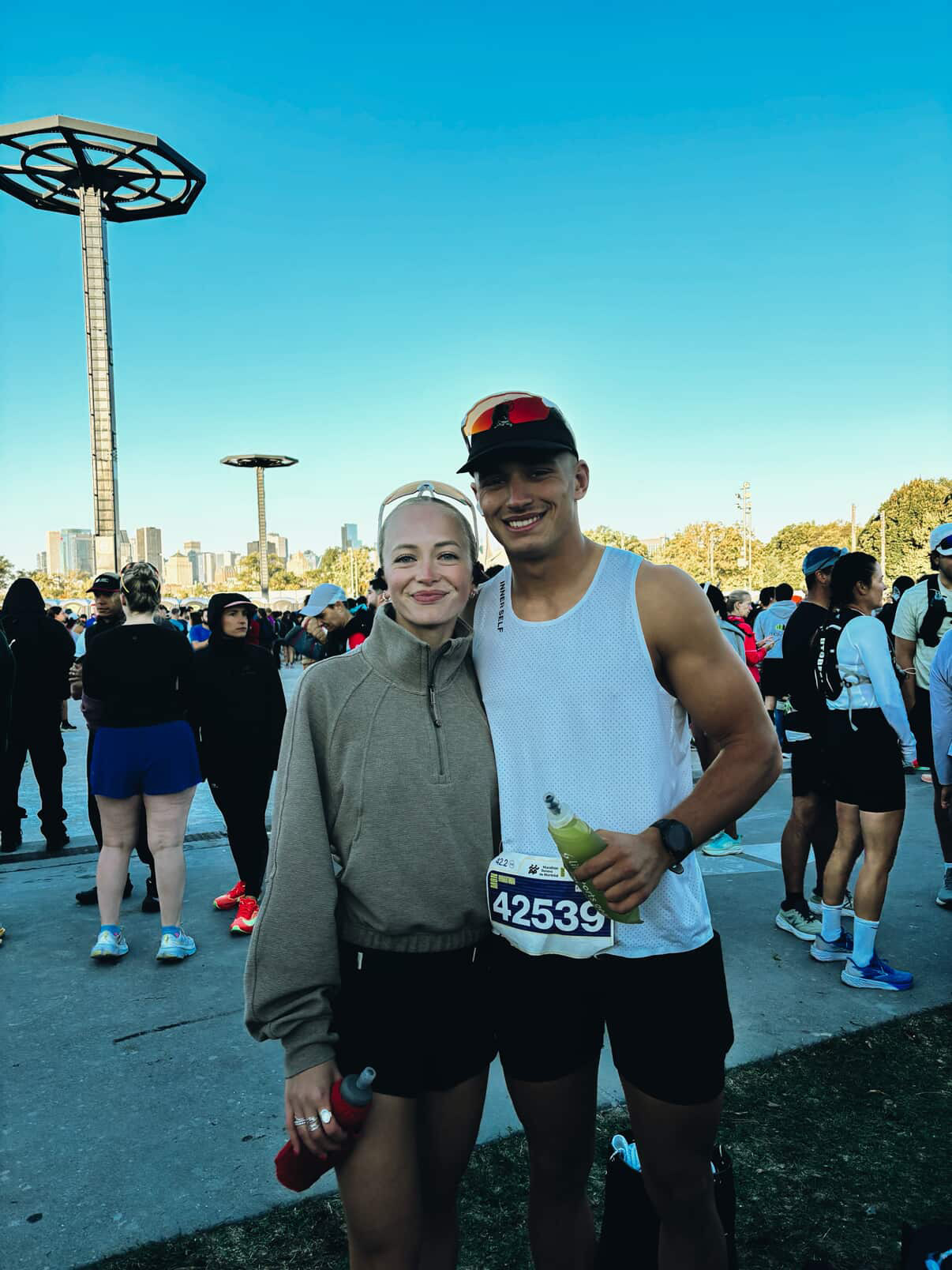
February is the month of love. In the running community, one question comes up again and again: do you really need to be with someone who shares your passion? We met two running couples with very different realities to explore what works (and what doesn’t) when two active people decide to be together.
Sharing the Same Passion: More Than Just a Perk
For Rachelle Dion and Louis Vallée, there’s no doubt about it. Triathlon takes up a huge amount of space in their lives, and having a partner who truly understands that reality removes a major source of friction.
“It’s really great when your partner shares your passion and understands what your life looks like,” Louis explains. “You don’t feel bad saying, ‘I have to do my long run.’ You know that, over time, it can be demanding and even create tension in a relationship.”
For Émilie and Nicolas, the dynamic is different, but the takeaway is similar. Nicolas was already a runner when they met, while Émilie rediscovered running through him. “Having Nicolas in my life pushed me to get back into running,” Émilie says. “It’s so much easier to build that habit together than on your own. Motivation can be hard when you’re alone.”
What stands out from both stories? Regardless of performance level, sharing the value of an active lifestyle creates a deep, mutual understanding. Nicolas sums it up perfectly: “I wasn’t necessarily looking for a runner, but I was looking for someone active. Living an active life matters.”
Sport becomes a positive anchor in the relationship. “We go for a run, we come back, we’re full of endorphins and in a good mood,” Rachelle says with a smile. “Sharing that with your person really brings something positive into the relationship.”
Syncing Schedules Without Losing Your Stride
Coordinating two training plans can quickly turn into a real headache. Rachelle and Louis found a solution: they share the same coach. “Our coach tries to give us similar workouts,” Louis explains. “It’s not always exactly the same because we’re at different levels depending on the discipline, but it rarely conflicts.”
That alignment helps them protect quality time. “On weekends, we do our long run in the morning, and then we’re free to do other things,” Rachelle says, also stressing how important it is to “see friends, spend time with family, and not always be together.”
For Émilie and Nicolas, the approach is looser. They train three to four times a week, without strict rules. “Let’s say one day I was supposed to run for an hour and a half, but I wasn’t feeling it, I’ll do 45 minutes,” Nicolas admits. “At least I did something.”
That flexibility helped them make conscious choices. After running the Marathon Beneva de Montréal in 2025, Nicolas decided to shift his focus to the half marathon. “Three- to three-and-a-half-hour runs were taking up too much space in my schedule. I see a much better balance between running and social life with half marathons.”
The couple also found a nice sense of reciprocity. Nicolas passed on his love of running; Émilie introduced him to gravel biking. “Now we both have gravel bikes and we plan camping trips just so we can ride,” she says.

Mutual Support, Zero Competition
Competition can easily creep in. But both couples agree: it’s the one thing to avoid.
“We see ourselves as a team—we support each other,” Louis says. “It’s about maturity.” Rachelle adds, “We’re genuinely happy for each other’s successes.”
For Émilie, comparison can still be tempting at times. “I stopped doing sports for a long time because of school,” she shares. “Running slower than I did at 20—it all adds up, and sometimes you’re like, ‘Come on!’” Rachelle, on the other hand, highlights how important it is that Louis treats her as an equal. “He trains with me the same way he would with a friend. I feel like he wants to push me up, not hold me back.”
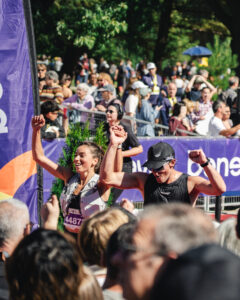
Support shows up in many different ways. During Nicolas’s marathon, Émilie followed him along the entire course on her bike. “She rode her single speed, moving from one cheering spot to the next. When I hit the wall at kilometre 36 and was walking three minutes for every minute of running, she was there the whole time. She never left my side.” Louis, for his part, bought a plane ticket to Spain to cheer on Rachelle during her second Ironman. “I knew how important it was to her, and I really wanted to be there,” he says simply. For Émilie, big gestures aren’t necessary. “Honestly, it’s the everyday support that meant the most,” she adds.
That mindset even helps them navigate tougher scenarios. “We’re doing the Tremblant half Ironman together,” Rachelle explains. “If one of us has a bad race and the other has a great one, it can be hard—but it’s not a competition. You learn to step aside and make space for the other person’s emotions.”
Beyond the Finish Line
Whether you’re chasing an Ironman or running a half marathon just for fun, one thing remains true: sharing the value of an active lifestyle strengthens a relationship.
“At the end of the day, it’s just about spending more time together doing something you love,” Nicolas says. “I might be running in zone 2 while she’s in zone 4 or 5, but I’m still spending time with my partner.”
For Rachelle, “at our level, having an athletic partner is really important. But even for someone who runs just for fun, I think it’s a great thing.”
The advice converges: avoid competition, respect each other’s needs, and see yourselves as a team. “It can’t be ‘I do my sport, so I don’t listen to your needs,’” Rachelle points out. “It has to go both ways.”
Émilie puts it simply: “Sharing the same passion takes your relationship to another level. We have fun being active together. It’s positive. We go for a run, we come back, we’ve got endorphins and we’re in a good mood.”
Published on 02/02/2026
CATEGORY Training