10 mistakes to avoid when training for the Marathon Beneva de Montréal
Tips from our CAMPUS mentors, straight from their own experience
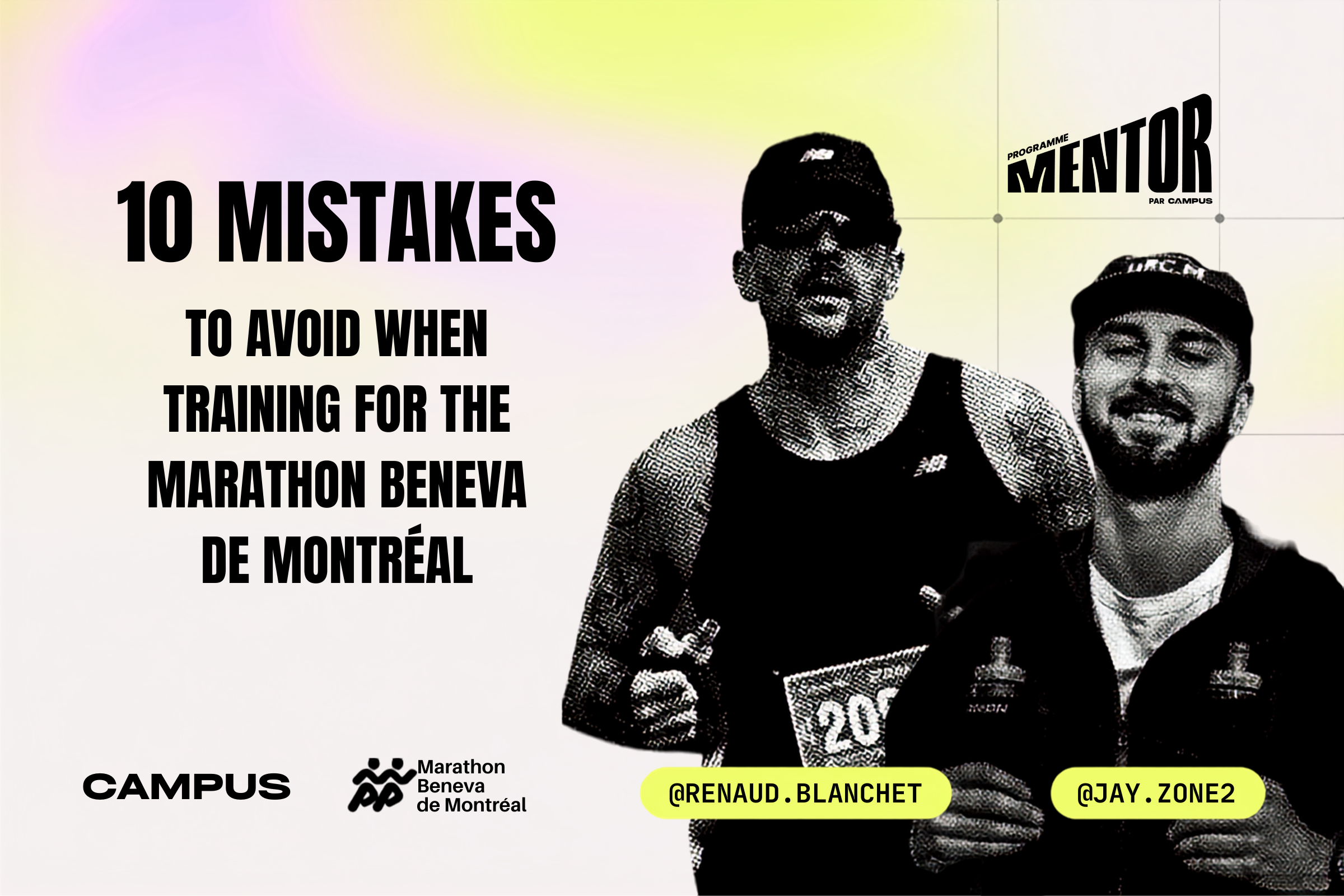
This year, CAMPUS named two mentors to support runners through their preparation for the Marathon Beneva de Montréal: Jay Zone 2 and Renaud Blanchet. Rather than giving a theoretical list of mistakes to avoid, we went straight to their stories—the real ones, lived on the course, with the wins and the hard lessons included.
Jay Zone 2 trained as a kinesiologist and found his calling as a running coach. His distance of choice is the half-marathon. “The sweet spot: it’s tough, it’s long, but it’s not hours and hours.” This year, he decided to tackle a full marathon, mainly to live the experience firsthand and become a better coach for his athletes.
Renaud Blanchet was born and raised in Montreal: running 42.2 km through his own neighbourhood is a deeply emotional experience for him. He got serious about running around 2020-2021. The marathon isn’t his favourite distance—the training load is hard to balance with the rest of his life. This year, he’s running the half-marathon at the Marathon Beneva de Montréal.
Here are 12 things they learned while preparing for long distances.
1. Skipping steps in your preparation
Going too hard, too fast, without building a proper base first—it’s probably the most common mistake, even among runners who know the theory inside and out.
“I did what a lot of people do: I started too hard. Even with the theoretical knowledge, I jumped straight into distances that were way too long. My first half-marathon, I ran it with barely any training. I struggled to finish, had a rough day, and ended up with both knees out of commission for a month.” Jay
And for anyone who thinks a 12-week plan is enough:
“The standard is 15 to 24 weeks of specific prep: around 14-15 weeks for a half, 20 to 22 for a full. But that assumes you already have a solid base and are training consistently. In reality, we’re easily talking about a year of training before you can safely take on a half or full marathon with enough volume to stay injury-free.” Jay
2. Setting an unrealistic goal—or trying to push hard from start to finish
A marathon plays out over 42 kilometres, not just the first 10.
“Even the pros will tell you: a marathon isn’t a distance you can run all-out from start to finish. It’s long enough that you have to manage your effort. I learned that the hard way—I held a pace that was too high for me, and when you hit the wall somewhere between kilometre 25 and 35, you’re completely cooked.” Jay
Renaud adds that a solid goal needs to be grounded in real data, not a number you pull out of thin air:
“You have to understand that running 21.1 km isn’t a normal thing to do. I used my progress, year after year, to figure out what I was actually capable of before setting goals. Three years ago, if someone had told me I’d be running a marathon at the pace I run today, I never would have believed it.” Renaud
3. Ramping up your long runs too fast
Increasing your long run distance too quickly is one of the easiest ways to get hurt before you ever reach the start line. Jay shares that, after coming back from an injury, he had to relearn how to start small—letting go of the numbers and giving his body time to adapt before building volume again, rather than picking up where he left off.
“The classic beginner mistake is chasing good times and big distances right out of the gate. I tried to do too much, ran too fast, and ended up sidelined for six months. Now, when I start a new season with a goal in mind, I never go back to the volume I was at before. I start really low and build week by week, always making sure to work in a recovery week before pushing higher again.” Renaud
4. Not having a carb and nutrition plan
A lot of runners underestimate just how important carbohydrates are—not just on race day, but as something to actively practise in training.
“Carbs are the body’s primary fuel for endurance. We don’t store enough for a long effort—anyone who’s hit the wall after 90 minutes knows exactly what that feels like. Don’t be afraid to eat them, and get used to fuelling during your runs so race day feels natural. The science is clear: the more you practise, the better you feel and perform.” Jay
Renaud gets increasingly precise with his nutrition as race day approaches:
“I work on my nutrition well in advance. As the weeks go by, I get more and more specific about how many grams of carbs per hour I’m taking in during training, so I know exactly how I’ll feel on race day.” Renaud
5. Neglecting hydration
Too much, too little, or just improvising—hydration is one of the most mismanaged parts of racing, in training and on race day alike.
“That’s exactly what happened to me at the Longueuil Marathon: I didn’t drink enough. I was skipping refuelling stations, and with the heat, my heart rate was spiking by kilometre 13. I finished, but I spent about an hour in the medical tent afterward. Now, no matter the distance, I always carry my own bottle: cold water and electrolytes, in a carrier that stays out of the way. And even with water on me, I still stop at every refuelling station: one sip to drink, one to pour over my body. It makes a real difference in keeping your temperature and heart rate in check.” Renaud, CAMPUS mentor
6. Wearing brand new, untested gear on race day
The rule is simple, but too many people still learn it the hard way: nothing new on race day. Jay has never raced in untested gear; he’s too meticulous about preparation to take that chance. Renaud lives by the same rule: he tests everything well in advance and sticks to the same kit from race to race, never changing anything at the last minute.
7. Skimping on mental and logistical prep
Physical preparation is one thing. Managing stress, sleep the night before, and the pressure you put on yourself is another, and it’s usually the part that gets the least attention.
“I remind myself that, at the end of the day, it’s just running: nobody’s life is on the line. Even with performance goals, my priority is still having fun, smiling, and high-fiving people along the way.” Jay
Renaud actually leans into the pre-race buzz rather than fighting it:
“I genuinely love race eve; it’s so exciting. The nerves are totally normal when you’ve set goals and want to hit them, but it doesn’t feel like stress to me. I’m just happy. If I spot someone stressed in the starting corral, I tell them: soak it in. It’s a beautiful course, nerves are normal, but channel them. Use that energy. We paid to be here. Might as well enjoy every second of it.” Renaud, CAMPUS mentor
8. Letting your ego run the show and comparing yourself to influencers
Ego is probably the biggest enemy of a solid training plan, whether it means pushing farther or faster than your body is ready for, or holding yourself up against what you see on social media.
“People tend to think five kilometres is the bare minimum, like anything less doesn’t count. But who decided five kilometres was the right distance for you? You have to put your ego aside and start small, whatever that looks like for you. It’s about what your body can handle, not what everyone else is doing. The biggest trap on social media is putting influencers’ training or their lifestyle on a pedestal. But I run the same kilometres as everyone else. I have the same doubts. There is nothing different between an influencer and anyone else on that start line.” Jay
9. Ignoring pain that keeps coming back instead of getting it checked
Recurring pain isn’t something to push through; it’s usually your body’s only warning before something more serious takes you out.
“I was hurting for two, three races in a row and just kept going. It turned out to be the beginning of a stress fracture, which I probably avoided by seeing someone right away. I pulled out of my race and took four weeks off, even though the pain wasn’t that intense, because I knew it was the right call.” Jay
10. Leaning on recovery gadgets instead of sleep and nutrition
Between compression boots, massage guns, and tracking apps, it’s easy to lose sight of the two things that actually make the biggest difference.
“There’s no shortage of recovery tools promising better performance. But the truth is, sleep and nutrition account for the vast majority of your recovery. Supplements and tech might add a percentage point or two, but it really is that simple: sleep well, eat well.” Jay
Renaud echoes that, with the perspective that comes with experience:
“With age comes wisdom. I’m a lot less stressed these days, and I’ve learned that a rest day is actually one of the best investments you can make in your performance. Most of your gains happen during recovery; push through without respecting recovery, and your progress will stall.” Renaud
Bonus: their best piece of advice, in one line
If there’s one thing to take away from each of our mentors before race day:
“My priorities will always be fun, smiling, and high-fives.” Jay
“Just respect who you are and respect how far you’ve come.” Renaud
Published on 09/10/2026
CATEGORY Training